
Why more detail made your team less sure what to do
Meaning arises not from the accumulation of detail but from selectively reducing detail into useful and coherent patterns.
— Refining Reality, Chapter One, "The Map and the Territory"
Imagine a team that has missed its commitments for several quarters running. The natural reading is that it isn't planning carefully enough, so it plans harder. Estimates get more granular, until every task for the year carries a number of hours. Designs get more thorough, until they specify the implementation line by line. Each step is sensible. Nobody wants to miss again.
The first thing to go is the ability to prioritize. With everything costed to the hour, nothing stands out from anything else. Then motion goes. Engineers wait on designs, designs wait on estimates, and meetings fill with status on the plan rather than the product. Everyone is busy. The team is chaotic, loud, tense, and somehow stalled. Ask what they are working on and you get a laundry list of tasks. Ask what is going to production and there is a pause.
The team wanted clarity. It pursued clarity through detail. And the more detail it gathered, the less it knew what to do.
A map exists to get someone somewhere. That is its entire purpose, and everything about a good map follows from it. A map works by leaving things out. It compresses a territory too large to hold in mind into a representation small enough to carry, and in doing so it tells you what matters: this road, not those fields; this ridge, not every stone on it. The value of a map lies precisely in the detail it discards.
For your team, the map is your strategic intent—a form of purposeful abstraction that narrows possibility space while maximizing meaningful impact—encoded in whatever form it takes: a set of objectives, a roadmap, three outcomes on a whiteboard, a sentence the leader repeats until everyone can say it. The form is incidental. What makes it a map is that it compresses everything the team could do into the few things it should, and that it was made to guide. Strategy, in Refining Reality, is exactly this coarse-grained thinking—direction at a scope and horizon where implementation detail would only get in the way. Tactics are the fine-grained work of getting there. Both are necessary. But they live at different altitudes, and a map drawn at the altitude of tactics is not a map.
Detail erodes abstraction, and abstraction is what carries meaning. Every hour estimate added to the plan, every section added to the design, makes the artifact more faithful to the work and less able to say what the work is for. Past a certain point the plan stops narrowing the team's choices and starts multiplying them: a hundred costed tasks with nothing to separate the signal from the noise. The team is not short of information. It is short of meaning. It went looking for meaning and found detail. So it looks harder, gathers more, and the map dissolves a little further. This is the Territory Without a Map—not a team with no plan, but a team whose plan has grown until it is indistinguishable from the territory it was meant to simplify.
Notice what is forgotten. Not the plan. Not the work. The purpose of the map—to guide. It is lost in the pursuit of fidelity, and with it the team loses the ability to connect its actions back to strategic intent. The team becomes aimless, and aimlessness looks like a hectic rush for clarity through brute-force activity.
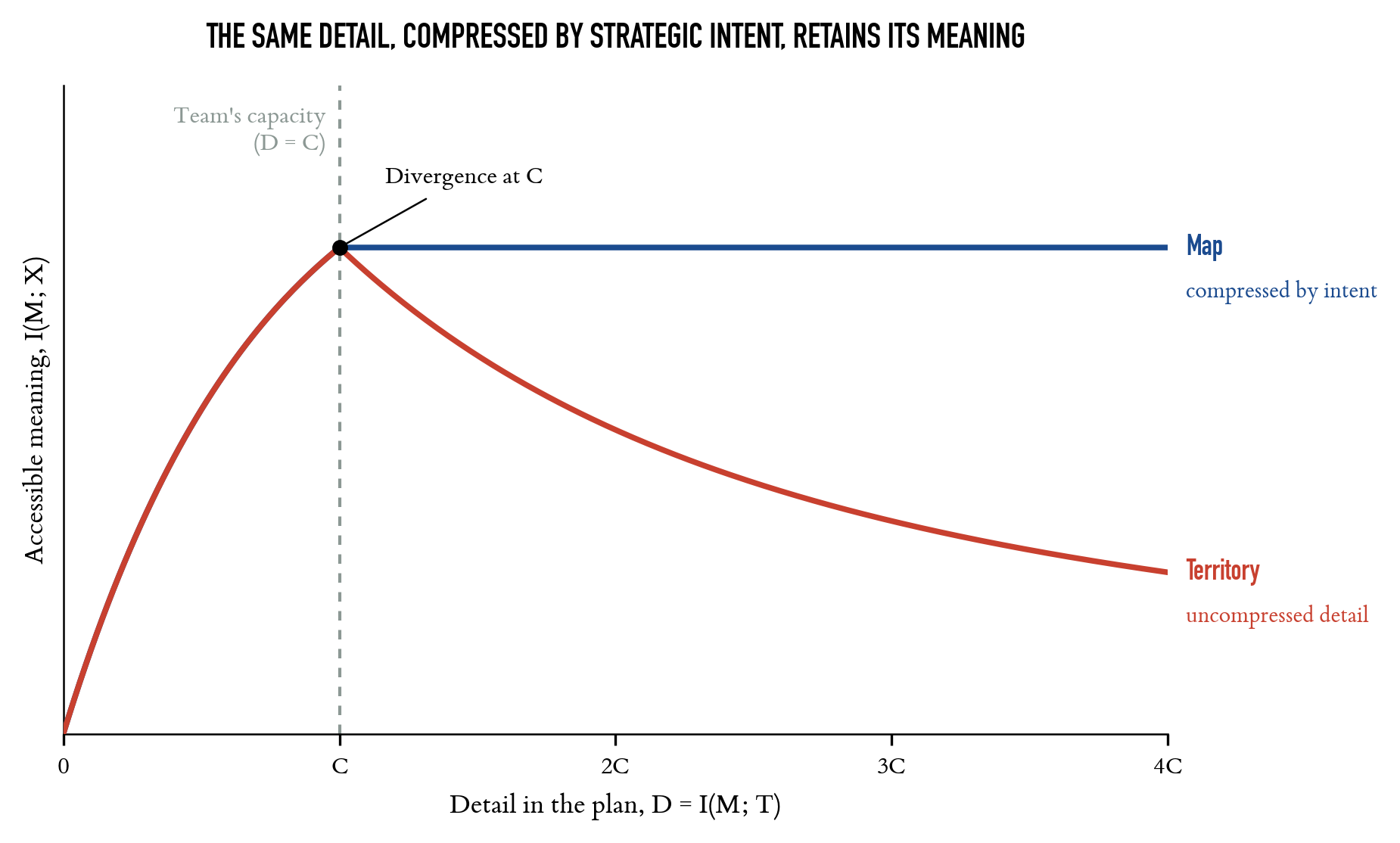
The response, and it runs against every instinct, is compression. Not more information, not more data, not a finer plan—each of those feeds the loop. Strategic abstraction. The figure below shows why.
Figure 1: What a team can act on as its plan gains detail: compressed by strategic intent (a map) versus uncompressed (a territory) · Refining Reality, 2026
The horizontal axis is how much detail a strategic plan carries. The vertical axis is how much of that detail the team can actually use to make decisions. Every team has a limit—the attention, time, and working memory it can bring to any one decision—marked here as its capacity. Up to that limit the two curves are one curve: every bit of detail is read, and the more the plan says, the better the team can choose. Past it, they part. If the detail is compressed by purpose—if the team can tell which of it matters—the plan keeps its meaning however much is added beneath. If it is not, the plan peaks at the team's capacity and then declines, because every added item dilutes attention without telling anyone what to do. A map is compressed detail. A territory is decompressed detail. The leader's task is to move the team from the lower curve to the upper one by restoring purpose and strategic intent.
Notice who does the compressing. The map tells the team what the work is for. But which items are signal and which are noise depends on the territory, and only the team stands in the territory. A leader who hands down a stacked list of tasks has not supplied a map. They have guessed at the ground from altitude, and in doing so taken from the team the one judgment it is positioned to make. Strategic intent does the opposite: it equips the team to choose—to decide for itself what to do next and what to leave—and that choice is where agency crosses from leader to team. Refining Reality calls this boundary the Line of Agency. Above it, the leader's work is purpose. Below it, the team's work is choice. A map is what lets the line be crossed.
There are three distinct ways this happens, and every Territory Without a Map involves at least one of them. All three share one cause: disconnection from purpose. In the terms above, each is a way the compression is lost, and the team slips from the upper curve to the lower one.
The Territory Without a Map announces itself through activity, not silence. Several of these will be true of a team that has lost its map.
One test cuts through the rest. Pick any item on the plan and ask, without warning: what will be different when this is done? A team with a map answers in a sentence. A team without one begins to explain the item.
If few of these are true of your team, its trouble is likely something else. Teams go wrong in more ways than this one, and a different Insight will serve you better. But if most of them are true, read on, and take the assessment below with your own team in mind.
The shift is simple to state and hard to hold: stop demanding clarity from the team and start supplying it. A lost team draws out of its leader a demand for more—more detail, more precision, more commitment—and every one of those demands pushes more uncompressed bits through a channel already past capacity. The leader's actual work in this moment is to restore the compression. Climb to the altitude of strategy, say what matters, and hand the team a map small enough to carry. The order in which to do things is not yours to give. It is theirs to find, and the map is what lets them find it.
Get clear in your own mind first. Before saying anything to the team, write the purpose of the team in a sentence or two. What problem does it exist to solve, for whom, and what would be observably different if it succeeded this year? That sentence is what every bit of detail will be judged against. If you cannot write it, nothing can be separated from noise, the team cannot know it, and no amount of planning will substitute. This is the fundamental act of strategic abstraction, and it does not delegate.
Reassert the purpose, out loud, in whatever form fits. Objectives, a one-page strategy, three outcomes on a whiteboard. The vehicle matters far less than the act. The point is to narrow the possibility space so that most of what is on the plan can be seen, plainly, as not serving the purpose. Expect relief more than resistance. Teams that have been drowning in detail are usually grateful for a shore.
Supply the criterion, not the order. The temptation, once the purpose is clear to you, is to finish the job: rank the backlog, hand it down, and call that a map. Resist it. You do not have the empirical grounding to know which item comes first; the team does, because it stands in the territory. A stacked rank from above is a map drawn at the altitude of tactics, and it takes from the team exactly the choice that strategic intent was meant to give it. Say what the work is for. Let the team decide what that makes most important today. That handoff is the Line of Agency, and crossing it is the point.
Make it a daily practice, not an announcement. Purpose decays; the leader is the energy that holds it in place. Open meetings with it. Ask people, without ceremony, what the objectives are—everyone should answer from memory. Trace decisions back to it in the room, so the team learns to do the same. A leader who states the purpose once a quarter has not set it. A leader for whom it is the subtext of every interaction has.
Stop asking for precision you do not need. Demand predictability and you will get it—predictable failure. Ask instead for the least detail that lets the team take its next step with confidence. Designs should guide implementation, not be it. Estimates should inform a choice between options, not certify a commitment. If an artifact has stopped changing what anyone does, stop producing it. And if the team already knows what to do next, it should do it, not plan to do it.
Reward the purpose, not the tactics. Look at who was praised last month and for what. If it was for heroics, estimation, or process, the team heard you. Recognize outcomes: the thing that shipped and the problem it solved. Even a help desk does not exist to close tickets; it exists to keep people working. Reward the purpose and the firefighting fades on its own.
One caution. Abstraction has a failure mode of its own. A leader who restores the map and then stops testing it against the ground drifts into the opposite trap, the Map Without a Territory, where the plan becomes more real than the work. That is the subject of its own Insight. For now the discipline is this: hold the purpose steady, keep the detail to what the next step requires, and watch what actually ships.
The high-level planning and direction that guides decision-making toward desired outcomes, typically operating at longer time horizons and broader scope than tactics. Strategy characterizes the upper half of the y-axis, using coarse-grained thinking to manage complexity at scale. Organizations develop strategy when creating roadmaps, vision, or capability models that establish direction without prescribing every implementation detail.
The diagonal boundary that divides the quadrant space from QII (Strategic Expansion) to QIV (State Collapse), marking where a fundamental shift occurs in who drives the refinement process. Above this line, leader agency dominates; below it, system agency takes precedence. This line represents a computational boundary determining how control and creativity distribute throughout the system.
Can you set a purpose, compress it into a map the team can carry, and keep it alive under pressure? Answer about your current team and your own behavior over the past month, not your intentions.
Knowledge without application remains mere indulgence. Write your answers down. The assessment has shown you something about your current state; these questions are how you turn that into a change in how you lead. Begin with yourself, then widen to the team.
The other half of the map
This essay took one side of a chapter. Chapter One of Refining Reality, “The Map and the Territory,” also covers the opposite trap: the Map Without a Territory, where the plan becomes more real than the work. It sets out how to ground your map in evidence and keep testing it against what actually ships. The whole model follows from there.
This section derives Figure 1.
Detail loses its meaning only when it is uncompressed, and strategic abstraction is the compression that restores it. The loss happens not in the map, but in the computationally bounded reader. Here is why.
Claude Shannon defined information as the resolution of uncertainty,[1] and his mutual information \(I(A;\,B)\) counts the bits that knowing \(A\) removes from our uncertainty about \(B\).
Call the territory \(T\): everything that is true about the work.
Call the map \(M\): the compressed representation the team actually carries.
And call \(X\) the thing the map exists to guide—the decision about what to do next.
Two quantities follow directly.
D = I(M;\,T)
the map's detail: how much of the territory it reproduces, in bits
I(M;\,X)
the map's meaning: how much it resolves about the decision, in bits
Where:
\(T\) = the territory, the full state of the work\(M\) = the map, a compressed encoding of \(T\) such as a roadmap or a set of objectives\(X\) = the decision the map exists to guide\(I(A;\,B)\) = mutual information, the bits that \(A\) provides about \(B\)\(D\) = detail, the information the map carries about the territoryTishby, Pereira and Bialek called \(I(M;\,X)\) the relevant information in a map: the bits that bear on the decision, as distinct from the bits that merely describe the territory.[2] For any amount of detail \(D\) there is a best possible map, the one that packs the most relevant information into that many bits. Plot that best case against \(D\) and the curve rises, flattens, and never falls.[3] A map can never carry more about the decision than the territory it was drawn from. But given more detail, it never carries less. More detail is never worse.
But that assumes a reader with unlimited capacity. No such reader exists. The decline in meaning that every leader has felt is not a property of maps. It is a property of readers, which are computationally bounded observers.
A team reads its map through a channel of finite capacity. Call it \(C\) bits: the attention, meeting time, and working memory the team can bring to any one decision. Herbert Simon stated the economics in one line—that a wealth of information creates a poverty of attention.[4]
When the map's detail \(D\) exceeds the reader's capacity \(C\), only part of it gets read. Which part depends on whether the map is compressed. In a Territory Without a Map it is not. Every costed task looks like every other costed task, because the thing that would separate signal from noise—the abstraction, the purpose—is exactly what has been lost. So the team absorbs a fraction \(C/D\) of the territory at random, and catches the signal at that same rate:
M_{\mathrm{territory}}(D) = I_{\mathrm{rel}}(D)\,\min\!\left(1,\,\frac{C}{D}\right)
Where:
\(Meaning_{\mathrm{territory}}(D)\) = the meaning actually delivered to the team by uncompressed detail \(D\)\(I_{\mathrm{rel}}(D)\) = the best relevant information available at detail \(D\)\(C\) = the team's capacity, in bits\(\min(1,\,C/D)\) = the fraction of the detail the team can absorb: all of it below capacity, a shrinking share aboveBelow capacity the whole territory is read and meaning rises with \(I_{\mathrm{rel}}\). Above capacity \(I_{\mathrm{rel}}\) has already saturated while \(C/D\) keeps falling, so meaning declines. The peak sits at \(D = C\). That is the lower curve.
Now give the same team a map: strategic intent that tells it what \(X\) is, so that it can tell signal from noise for itself. It reads the signal first:
Meaning_{\mathrm{map}}(D) = I_{\mathrm{rel}}\big(\min(D,\,C)\big)
Same team. Same capacity. Same detail. Meaning rises to the capacity and holds there. It does not fall, however much detail accumulates beneath it, because the map keeps the signal at the front of the channel. Detail is not the enemy; uncompressed detail is. Strategic intent is what makes the compression possible. That is what makes a map a map, and it is why restoring the map, not shrinking the plan, is the leader's job.
Notice, too, who holds what. \(X\) comes from the leader. \(T\) is known only to the team. Relevance—which bits are signal—depends on both, so neither can compute it alone. The equation has the Line of Agency built into it.
One consequence is worth drawing out, because it explains the team conflict. Unread detail is not inert. A channel's usable rate falls as noise rises relative to signal,[5] and in a plan with no compression the irrelevant bits do not merely go unread—they get acted on. Two senior engineers spending a week on whether a task is eleven hours or fourteen are decoding noise as signal. The arguments that arise in a Territory Without a Map are not a personality problem. They are a channel operating below its signal-to-noise floor.
Meaning as \(I(M;\,X)\) assumes a defined decision \(X\), and choosing \(X\) is itself a strategic act—the mathematics inherits the purpose, it does not supply it. And \(C\) stands for bounded attention, not a quantity anyone has measured. What the model gives is not a number but a shape, and an exact statement of where that shape comes from.
The model in Figure 1 is illustrative. Its shape follows from references 1, 2 and 3 as described in The Mathematics of the Map; the curves use I_rel(D) = 1 − 2^(−D/k) with k = 1.5 and a capacity C of 3 bits—a convenient saturating form, not a measured one. In the limit, the slope past capacity becomes a cliff: Wolfowitz's strong converse shows that above capacity the chance of decoding correctly falls to zero as the message grows.[6]
